





Guest Post by Mandy Froehlich
Connecting SEL Into Lessons
A challenge that I regularly hear teachers discuss is how they can possibly fit social-emotional learning (SEL) into their day. Even if you believe in the Maslows before Bloom philosophy, the idea of trying to fit in one more thing can feel overwhelming, and oftentimes there isn’t the professional learning opportunities provided in SEL that lay the foundation for fitting those types of lessons seamlessly into the curriculum. The fact is that social-emotional competency is crucial to learning. So how can we mix it in?
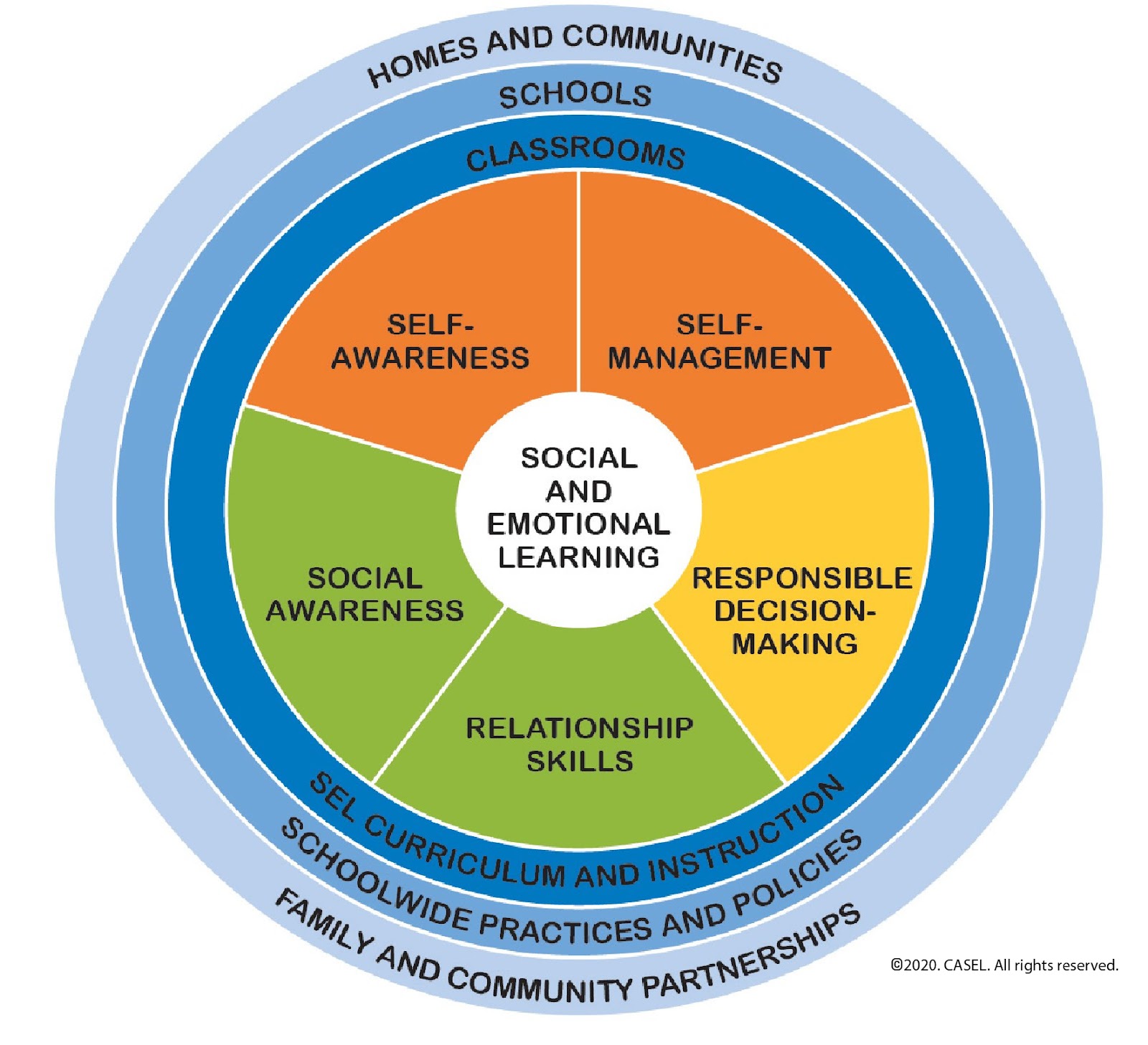
I subscribe heavily to the CASEL framework and regularly use the competencies when working with teachers both for their own social-emotional support and their students’. The truth is, you’re probably doing many things that already address the competencies. Sometimes it’s not about what we are doing but rather little tweaks we can make to address the competency in a more impactful way. The examples below may sound like activities that you do in your classroom already. What adjustments (if any) do you need to make?
Open-Ended and Socratic Questioning (Self-Awareness, Self-Management, Social Awareness)
While planning for discussions be sure to take out closed-ended questions and replace them with critical thinking questions. For online learners, these questions are perfect for discussion boards or as discussions in a synchronous session. These questions will sound like:
- How is this [similar to/different from] something we’ve seen before?
- What do you know, or think you know, about ___________?
- What do you believe about______? Why? Be ready to defend your answer.
Cultural Responsiveness (Social Awareness, Self-Awareness, Relationship Skills)
Ensure cultural responsiveness by looking for places to link content to experiences and frames of references. Be intentional about bringing in content that students can see themselves in. Anticipate support that individual students might need in order to access material and participate fully in a meaningful way for them.
Collaborative Opportunities (Potentially All Five Competencies)
Collaborative opportunities give students the opportunity to practice their decision-making skills, relationship skills, and develop social awareness. Examples of collaborative opportunities would, of course, be projects but there are shorter opportunities for collaboration, reflection, and processing by using Think, Pair, Share, Turn To Your Partner, or small groups.
Already do some of these things? I thought so. And if not, they are easily integrated. Social-emotional learning should be a part of our everyday curriculum so it’s not something else we need to do, but instead weaved seamlessly into what we already do.
About the Author

Mandy Froehlich
Author, Consultant, Adjunct
Director of Author Success EduMatch Publishing
Co-host BAM! Radio Network’s Teacher’s Aid
Mandy Froehlich passionately encourages educators to create innovative change in their classrooms. A former Director of Innovation and Technology, technology integrator, and teacher, she has experience at many levels of the organizational structure. Her interest lies in reinvigorating and re-engaging teachers back into their profession, as well as what’s needed to support teachers in their pursuit of innovative and divergent thinking and teaching. She consults internationally with school districts and post-secondary institutions in the effective use of technology to support great teaching, mental health support for educators, and how to create organizational change. She is also an adjunct for the University of Wisconsin – Oshkosh where she works with graduate-level educators in a leadership and technology course.
-

ReadWorks and the Power of the Daily Article Routine
ReadWorks is a free, research based, tool to aid in reading comprehension. Try the Article-A-Day to save time and provide differentiated options for readers.
-

DOK = Critical Thinking
DOK is the measurement of critical thinking on a task. Better understanding Depth of Knowledge helps you to better incorporate critical thinking into lessons.
-

3 Google Sheets Shortcuts You’ll Actually Use
The answer is always a spreadsheet, but sometimes the tips are hard to remember to implement. Practice these 3 Google Sheets shortcuts to really help