






Creating a learning environment that prepares students for a world full of complex problems is a goal every educator shares. We all want to provide a high quality education that empowers our students to be more than just processors of information. In an era where information is instantly available, our value as teachers lies in our ability to train students in creative critical thinking rather than competing with what computers can do. To achieve this, we need a common language and a framework to measure the cognitive “heavy lifting” we ask of our students. This is where Depth of Knowledge, or DOK, comes in. DOK is a measurement of critical thinking.
What is DOK?
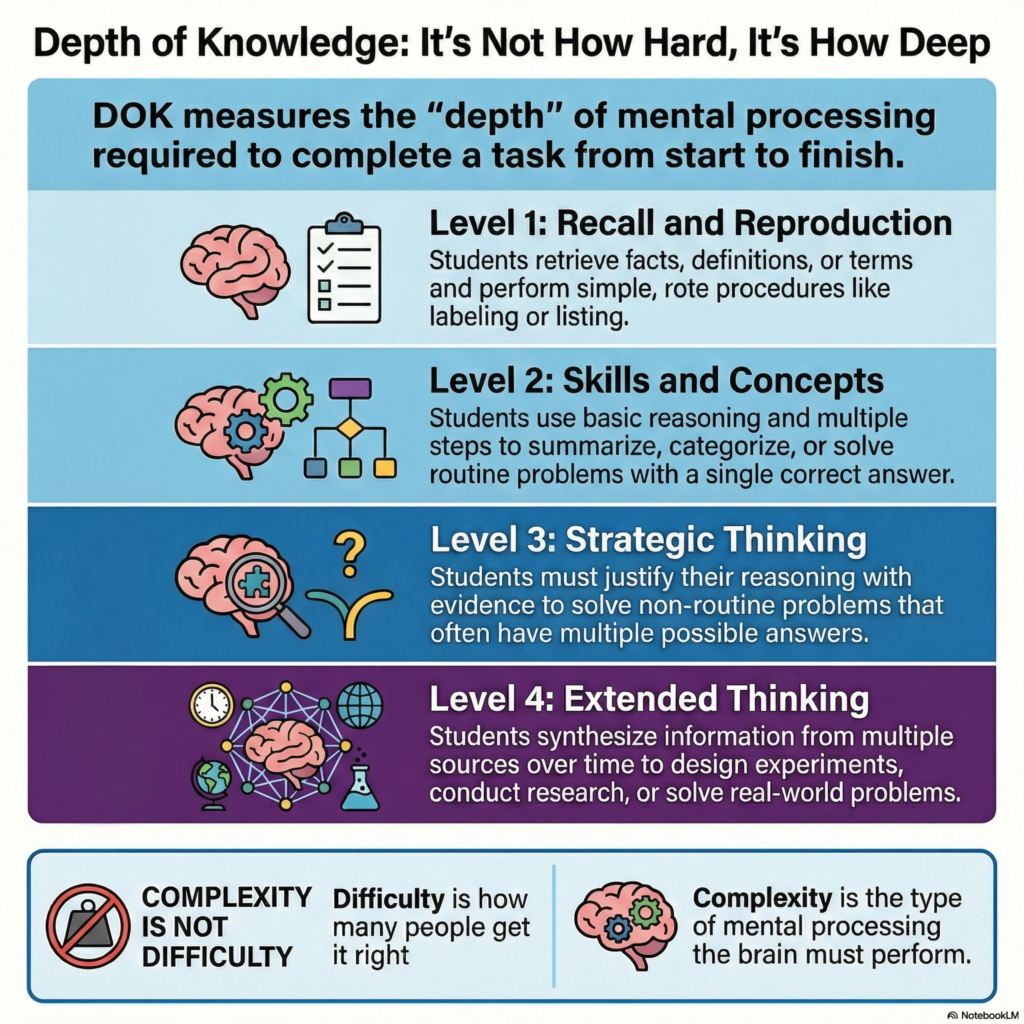
Developed by Norman Webb, Depth of Knowledge is a framework used to analyze the cognitive demand of a task, an assessment, or a standard. Unlike other models that focus on the verb used in a prompt, DOK looks at the complexity of thinking required to complete a task. It helps us see past the surface level difficulty of an assignment and focus instead on the complexity of the mental processing involved. By understanding the four distinct levels of DOK, we can more effectively design learning experiences that foster genuine intellectual growth.
Verbs do NOT define DOK.
Defining the 4 Levels of DOK
Level 1: Recall and Reproduction
This involves the most basic cognitive effort. Students are asked to remember facts, terms, or simple procedures. If a student can find the answer by simply looking it up or following a set of steps, it is Level 1.
A recipe of directions.
Level 2: Skills and Concepts
At this level, students move beyond simple recall to perform tasks with more than one step. This often involves summarizing, classifying, or comparing and contrasting information.
A common misconception is if it takes more than one step it is DOK 2. The quadratic formula is multiple steps, but it is still DOK 1, as students are following directions.

Delivering high-quality content, tools, and support for reading comprehension
ReadWorks is a free, research-based website designed to support educators in teaching reading comprehension across grades K–12. It provides a rich library of high-quality, standards-aligned instructional content.
Article-A-Day, helps students build knowledge and vocabulary in just 10-minutes a day.
Level 3: Strategic Thinking
This is where critical thinking begins in earnest. Students must use reasoning, planning, and evidence to solve a problem. There is often more than one valid approach or answer, and students must justify their choices.
Make a claim and justify it with evidence.
Level 4: Extended Thinking
This level requires complex reasoning and investigation over an extended period. Students synthesize information from multiple sources or content areas to solve real world problems.
Complexity is the Goal
Depth of Knowledge is not a taxonomy of difficulty. It is a measure of cognitive demand. You can have a DOK 1 task that is very hard, but it remains DOK 1 because the mental process has not moved past retrieval or following a simple, scripted procedure. Difficulty is often about how many students get the answer right, while complexity is about how many types of thinking are required to reach that answer.
DOK 3 and 4 are where students begin to engage in higher order thinking. These levels require students to make choices and use reasoning. When there is only one right answer and only one predetermined way to get there, the thinking has already been done for the student. To move to higher DOK levels, we have to create space for ambiguity and decision making within the assignment itself.
DOK 1 Tasks That Mask as Higher Levels
It is a common trap to assume that if a task takes a long time or has a high failure rate, it must be high level. However, many difficult tasks are actually just high volume DOK 1. These assignments often look rigorous because they are rigorous in effort, but they are lacking in cognitive complexity.
| Subject Area | Task Description | Why it seems Hard | Why it is still DOK 1 |
|---|---|---|---|
| English Language Arts | Finding three examples of similes in a chapter of a novel. | The chapter is twenty pages long and requires students to stay focused while reading a large volume of text. | This is a search task. Since similes follow a predictable pattern using like or as, the student is simply matching a definition to a pattern in the text without needing to explain the author's intent. |
| Science | Conducting a 15-step chemistry lab where every step is provided in a manual. | The equipment is technical, the measurements must be precise, and any error ruins the result. | The student is following a recipe. No strategic decisions are made; they are reproducing a known procedure to reach a known outcome. |
| History/Social Studies | Creating an illustrated timeline of the American Revolution with 25 key dates and descriptions. | It is a massive research task that requires hours of drawing and careful sequencing. | Sequencing events chronologically is a basic cognitive skill. Unless students are asked to explain the causal link between events, it is just data entry. |
| Mathematics | Calculating the perimeter of a complex shape where every side is a different improper fraction with unlike denominators. | Students have to find common denominators and manage multiple steps of fraction addition. It is easy to make a small error that leads to a wrong final answer. | The concept being tested is perimeter. If the student knows the rule is to add all sides, the difficulty is just computational. No decision making or strategic thinking is required to understand the geometry. |
Challenging the Ladder Misconception
A common misconception is that DOK is a ladder where you must climb every rung to reach the top. Many believe you have to master DOK 1 before you can attempt DOK 3. This approach often leaves students stuck in a cycle of rote memorization before they ever get to do the interesting parts of learning. In reality, starting with a DOK 3 question is often a more effective way to engage students.
When we lead with a complex, high level question, we create a need to know. Instead of spending days front loading facts that feel disconnected from reality, we can present an intriguing problem that requires those facts to solve. Students then acquire DOK 1 knowledge naturally as they work through a DOK 3 or 4 task. This makes the foundational information more relevant and memorable because it is being used immediately to fuel critical thinking.
Instead of starting a lesson by providing the latin root and giving examples of the root, provide students with multiple use cases of the root and ask them to use context clues to determine what the stem means.
Evaluating the DOK of a Task
To determine the DOK level of an activity, do not look at the verb as an automatic indicator of level. We often look at the verb first, but we have to analyze how it is being used in context. A common mistake is assuming that verbs like “analyze” or “evaluate” automatically mean DOK 3. If a student is told to “analyze” a text by simply finding three facts they already discussed in class, that mental process is actually just DOK 1 recall. The level is not about the word you use in the prompt; it is about the complexity of the thinking the students actually engage in.
We also have to consider the student’s actual engagement with the task. You might design a perfect DOK 3 task, but if a student gives up or simply waits for the answer, they are not hitting that level. I often call “I don’t know” or a blank page DOK 0. If students engage with a complex task in a shallow way or use a tool to bypass the reasoning, the task effectively drops to a lower level. To keep the cognitive demand high, we must ensure the task requires students to make sense of the information and navigate a path to the solution themselves.
Educator AI Assistant

Collects NO User Data
Use AI to create lesson plans, rubrics, newsletters, anything you want.
Educator AI Assistant is different by collecting ZERO data. Shows you the prompt and allows you to edit and share.
Runs locally in your own Google Sheets™.
Fully transparent and customizable.
Created by AliceKeeler
The Difficulty Trap in Math
As a math teacher, I see a lot of premade resources or AI generated content provided for teachers that lack both critical thinking and creativity. These worksheets often present problems that are incredibly difficult but do not actually require a student to think deeply. We often confuse a high volume of steps or computational hurdles with cognitive complexity.
What DOK Is This Problem
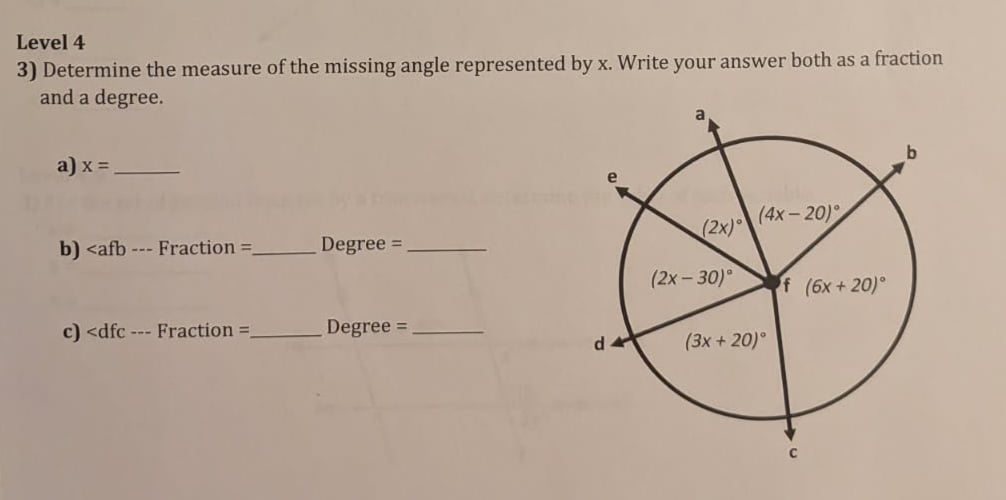
This problem is HARD. Solving for x we get 370/17. A denominator of 17 is very hard to work with. Then the student has to plug this value of 17 back into 4x – 20. Four time 370 over 17 minus 20 times 17 over 17. This gets us the degree… but written as a fraction. So we must then divide by 360 to calculate the degree to get the fraction.
This is honestly a nightmare of a calculation.
But did the nightmare fraction value increase the COMPLEXITY of the question? No. This question is not different than one where the circle is divided up into 3 instead of 5 segments and the value of x is an integer. We made it HARDER, but not more complex.
So what DOK level is this problem? Depends on how much scaffolding the teacher did.
IF the directions are
- If a circle is divided up into multiple segments, add up the values of each segment and segment and set it equal to 360º.
- Solve for x.
- Plug the value back into each segment to determine the angle measure of the segment.
- Divide by 360 to determine the fraction of the circle.
Follow these directions = DOK 1 even if it’s time consuming.
However, IF the previous directions are
- If a circle is divided up into multiple segments, add up the values of each segment and segment and set it equal to 360º.
- Solve for x.
and then we provide students a problem, without an example to mimic, and ask them to find the measure of each angle. This is an additional step beyond the instruction that the students have to figure out.
sheetPusher Add-on
Created by Alice Keeler. Collects NO user data.
Push values to multiple student spreadsheets.
Lock students from editing parts of their assignment.
Practical Ways to Elevate Your Lessons
Shifting a lesson from recall to strategic thinking does not require a complete overhaul of your curriculum. It often requires a simple pivot in how you frame the task. Moving a student from DOK 1 to DOK 2 is a significant win because it forces the student to pause and make sense of the information. The goal is to move from a scavenger hunt for right answers to an environment where students must make a choice or apply a concept in a new way.
| Subject Area | Typical DOK 1 Task | Elevated Task | Target DOK |
|---|---|---|---|
| English Language Arts | Identify the main character and list three traits. | Sort a list of character traits into categories that show how the character acts versus how they feel. | DOK 2 |
| Provide evidence to support which character trait is most responsible for the character's primary conflict in the story. | DOK 3 | ||
| Mathematics | Calculate the surface area of a rectangular prism using a formula. | Identify two different rectangular prisms that have the same surface area but different volumes. | DOK 2 |
| Determine the dimensions of a rectangular prism with a surface area of 20 square units that result in the maximum volume and justify how you know those dimensions produce the absolute maximum. | DOK 3 | ||
| Science | Label the stages of the water cycle on a diagram. | Identify which stages of the water cycle are currently occurring in a specific real world photo and explain how you know. | DOK 2 |
| Predict what would happen to the local environment if the evaporation stage of the cycle stopped for a month and support your claim with evidence. | DOK 3 | ||
| History / Social Studies | List the names of the first three American presidents in order. | Group the first three presidents by a shared challenge they faced and explain why you grouped them that way. | DOK 2 |
| Argue which of the first three presidents had the most significant impact on the current structure of the executive branch using historical evidence. | DOK 3 | ||
| Mathematics | Solve a linear equation for x using the exact same steps shown in the teacher's example. | Provide a solved equation with a different structure than the example and ask students to determine if the previous steps still apply. | DOK 2 |
| Create two different equations that lead to the same solution for x and justify why the different structures still yield the same result. | DOK 3 |
Moving Forward with Intentionality
I started my year by teaching my students the four levels of DOK primarily to keep myself accountable. This shift allowed them to take true ownership of their learning because they understood the depth of the work we were doing together. Mapping our DOK levels is really about being transparent with the work we ask of our students. When we recognize a task is at DOK 1, we gain the power to pivot toward the complexity they need to navigate a world that rarely provides an answer key. By labeling assignments with the DOK level and the specific standard, we signal that critical thinking is the priority while turning hidden pedagogical goals into clear, shared targets. Start small by choosing just one assignment or question this week and finding a way to elevate it from DOK 1 into a DOK 2 or 3.