



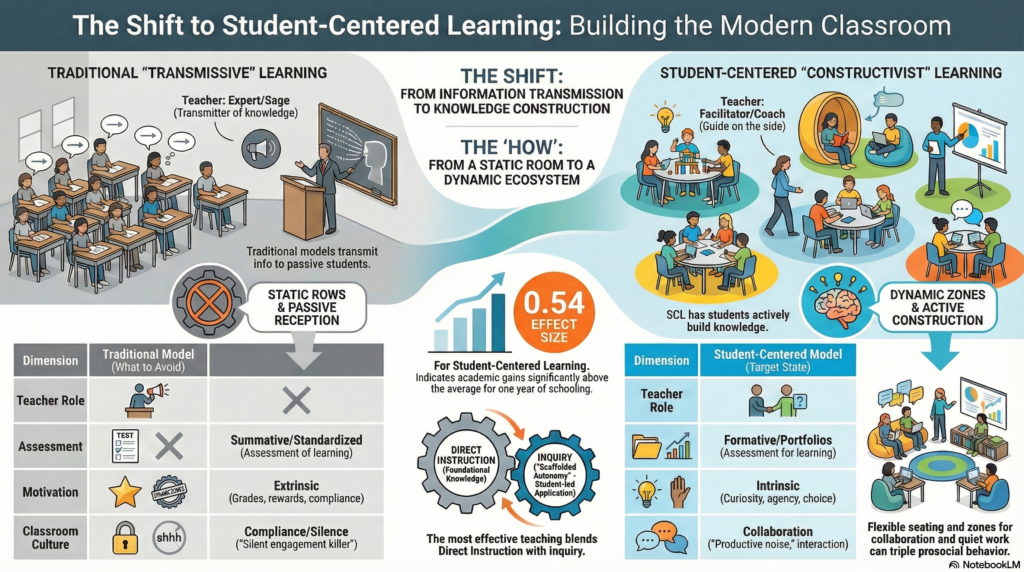
A new feature in Notebook LM is the ability to create infographics. Since my passion is student centered classrooms, I asked Gemini to do deep-research to provide information on the topic, added this to Notebook LM, and asked it to create an infographic.
I am more and more concerned about the use of technology to replace teachers with low critical thinking, low creativity, low collaboration tasks. Sitting students at a computer program to watch a video and answer quiz questions replaces dynamic classrooms with rote compliance. In an age of AI, we need more humanization, more interactions, more conversations, more critical thinking, and more complexity.

Delivering high-quality content, tools, and support for reading comprehension
ReadWorks is a free, research-based website designed to support educators in teaching reading comprehension across grades K–12. It provides a rich library of high-quality, standards-aligned instructional content.
Article-A-Day, helps students build knowledge and vocabulary in just 10-minutes a day.
Educator AI Assistant

Collects NO User Data
Use AI to create lesson plans, rubrics, newsletters, anything you want.
Educator AI Assistant is different by collecting ZERO data. Shows you the prompt and allows you to edit and share.
Runs locally in your own Google Sheets™.
Fully transparent and customizable.
Created by AliceKeeler
Tips for a Student Centered Classroom
I uploaded all of my books as well as the deep research by Google Gemini to Notebook LM and asked it for 10 practical tips to start building a student centered classroom.
10 Practical Tips
Creating a student centered classroom requires a fundamental epistemological shift from a transmissive model where knowledge is delivered by an expert to a constructivist model where students actively build their own understanding. This transition changes your role from the sole provider of information to a facilitator or coach.
If you have a cart of Chromebooks here are 10 practical ways to architect this environment.
1. Offer Authentic Voice and Choice
Providing students with meaningful choices is one of the most effective ways to increase engagement and ownership. When every student must complete the exact same task you may inadvertently measure their compliance rather than their understanding. By offering a menu of options you allow students to demonstrate mastery in a way that aligns with their personal strengths and interests while still meeting the same rigorous learning standards.
Chromebook Tip
You can create Digital Choice Boards using Google Slides. Build a simple grid on a slide and insert hyperlinks that direct students to different resources or activity descriptions. This allows students to navigate the options independently and select the path that works best for them.
Creative Option
When students choose to demonstrate their learning through visual means Google Workspace tools may feel limiting. Show students how to use Canva for Education to design professional quality infographics or posters. They can download their designs and upload them to Google Classroom as a finished product.
2. Utilize Collaborative Learning Spaces
True learning involves social construction where students wrestle with ideas together rather than working in isolation. Moving students from passive consumption to interactive engagement requires structures that make their thinking visible to one another. This shift transforms the classroom from a collection of individuals into a community of practice where peers serve as resources for one another.
Chromebook Tip
Use Collaborative Google Slides for this purpose. Assign one slide deck to the entire class and give everyone Editor access. You can assign each student or group a specific slide number to populate with their research or ideas. This allows students to see peer thinking in real time and builds a collective class resource that everyone can reference.
3. Shift from Autopsy Grading to Continuous Feedback
Traditional grading often acts as a terminal event that ends the learning process. It is like an autopsy because it tells you what happened to the patient after it is too late to save them. Student centered assessment focuses on providing actionable feedback while the learning is still happening. This approach encourages students to view their work as iterative and values the process of revision over the final grade.
Chromebook Tip
Utilize the Private Comments feature in Google Classroom or the Suggestion Mode in Google Docs. Engage in a back and forth dialogue while students are still cognitively wrestling with the work. You might even consider withholding the final score until the student has responded to your feedback or made a revision.
4. Implement Inquiry Based Challenges
Rote lectures often answer questions that students have not yet asked. A student centered approach reverses this dynamic by using the Five Es model (Engage, Explore, Explain, Extend, and Evaluate). By starting with a provocation or a driving question you create a need to know that motivates students to seek out answers. This anchors the direct instruction that follows in a meaningful context.
Chromebook Tip
Use a Google Form as an Inquiry Log. Before a unit starts have students submit their questions and hypotheses about the topic. As they learn they can return to the form to update their thinking or add new questions. This creates a digital record of the intellectual journey of the student.
5. Design a Physical and Cultural Ecosystem
The physical environment of a classroom communicates a lot about the expected behavior. Rows of desks facing the front signal that the teacher is the center of attention while clusters and flexible zones signal that collaboration is valued. Student centered learning struggles to survive in a rigid space so it is important to break up the graveyard formation of rows.
Chromebook Tip
Since Chromebooks are portable you should encourage students to move around the room. Designate a quiet zone where headphones are required for independent study and a collaboration zone where screens can be shared for group projects.
6. Empower Students as Co Teachers
In a traditional classroom the teacher holds all the responsibility for logistics and troubleshooting. In a student centered room these responsibilities are shared to build agency and community. Giving students real jobs helps them feel that the classroom belongs to them and allows you to focus on instruction rather than management.
Chromebook Tip
Create a Cyber Squad or Genius Bar composed of students. Train this small group to be the first line of defense for tech issues (such as formatting images or connecting to wifi). This offloads minor troubleshooting from you and empowers students as experts.
7. Curate Student Led Portfolios
Standardized tests only provide a snapshot of student performance on a single day. Portfolios offer a comprehensive view of growth over time and require students to exercise metacognition. When students select their own best work and explain why they chose it they develop a deeper understanding of their own learning process.
Chromebook Tip
Have students build Google Sites to house their work. They can embed their best Google Docs, link to video projects, and type reflections for each entry directly on the page.
Creative Option
Google Sites has limited design flexibility for headers and buttons. If students want to create a highly visual or branded portfolio header they can design it in Canva and upload the image to their Google Site to add personality and flair.
8. Collaboratively Create Norms and Social Contracts
Rules that are imposed from the top down are often followed only when the authority figure is watching. Norms that are co-created by the community are more likely to be internalized and respected. Facilitating a session where students brainstorm desirable behaviors shifts the culture from compliance based discipline to community responsibility.
Chromebook Tip
Use a shared Google Doc or Google Slide for the brainstorming phase. This allows all students to type their ideas simultaneously. It ensures introverted students can contribute their ideas about classroom culture anonymously and that every voice is captured.
Creative Option
Use Canva Whiteboards to allow students to add sticky notes and connect ideas visually on an infinite canvas.
9. Connect with Authentic Audiences
Work that is created solely for the teacher often results in minimum effort. When students know their work will be seen by a real audience outside the classroom the stakes are raised and quality improves. Connecting with the real world helps students see the relevance of their academic skills.
Chromebook Tip
Encourage students to create products for the real world. They can write emails to local officials about community issues using Gmail or present findings to experts via Google Meet.
Creative Option
When students need to present their findings to an external audience first impressions matter. They can use Canva to create professional newsletters or presentation slides that look more polished than standard templates.
10. Leverage AI as a Thought Partner
Artificial Intelligence is changing the way we work and think. Rather than banning it we should teach students how to use it as a tool for cognition. In a student centered classroom AI can act as a sparring partner that challenges students to strengthen their arguments or a creative collaborator that helps them brainstorm new perspectives. This keeps the interaction dynamic and ensures the student remains the expert who must judge the value of the output.
Chromebook Tip
Explicitly teach AI Literacy using Google Docs. Require students to submit their Prompt History alongside their final work. Ask them to annotate where they accepted or rejected the suggestions from the AI and explain why. This emphasizes the process of thinking over the final product.

The Importance of Human Connection
We must remember the importance of human interactions in a modern classroom. Computerized learning cannot replace the relationship between a teacher and a student. Technology is merely a tool to amplify our capacity to connect and create and think critically. A student centered classroom helps us create future ready students who are not just consumers of information but active citizens in a complex world.